
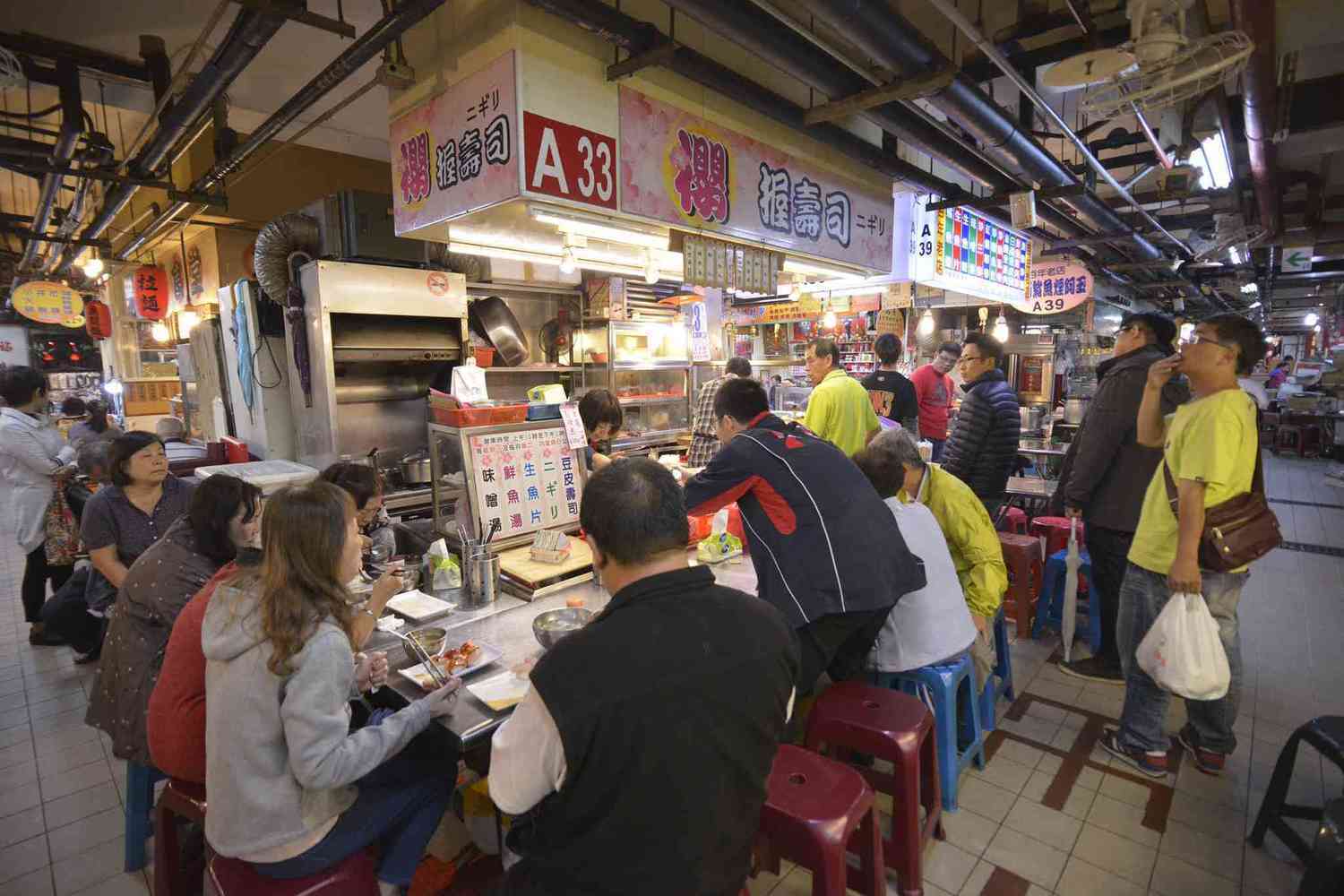
Keelung's Ren'ai Market boasts a plethora of food stalls, and Mayor Lin Yu-chang praised its cuisine, saying it rivals that of the Miaokou Night Market. Keelung's streets and alleys are filled with hidden gems of affordable, high-quality food. Cruise ship passengers are increasingly flocking to the markets, demonstrating the immense potential of the local economy. He hopes other districts will follow suit. Ren'ai District Chief Lin Wen-chen stated that the markets offer a concentrated and diverse selection of food; a stroll through the market reveals a wide variety of options. Air conditioning on the second floor provides shelter from the elements. After a meal, customers can shop for clothes, get their hair permed, or get manicures. Numerous long-established shops are also available. Notably, Keelung, as an international port, has a long-standing tradition of coffee drinking, and the market features several unique coffee shops. Many elderly people, from shoppers to those finishing their grocery shopping, take a break for a coffee, creating a distinctive atmosphere within the market.
Li Longjin, the head of Wen'an Village, pointed out that the predecessor of Bo'ai and Ren'ai Markets was the Keelung Bo'ai Group located in Fude Town (now the intersection of Ai'er Road, Ai'san Road and Ren'si Road). It was completed on October 14, 1922. It was a three-story cement brick building, with shops on the first floor and residences on the second floor and above. By 1980, the buildings had become old, damp and dirty, and were no longer suitable for living. The adjacent Fude Market (Ren'ai Market) was also dilapidated, crowded and dirty. Both buildings were built during the Japanese occupation period. Due to their age, they could not withstand the load and were afraid of becoming dangerous buildings. Therefore, the city government started demolition and reconstruction in 1983 and built two multi-purpose buildings, Bo'ai and Ren'ai. They were completed in October 1986, and the appearance of the city was greatly improved.