
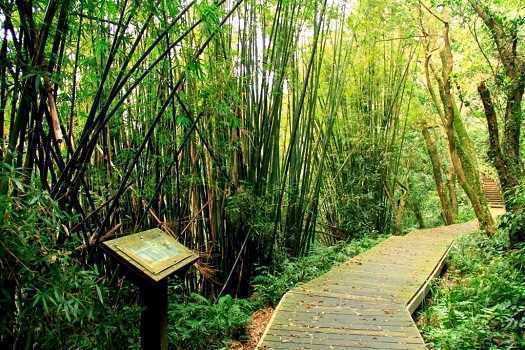
Laoliaokeng is located in the southeast of Nuannuan District, at an altitude of approximately 350 meters in the upper reaches of the Dongshi River. According to historical research, the locals originally called "Laoliaokeng" "Naoliaokeng," with "Nao" referring to camphor and "Naoliao" being a temporary dwelling for logging camphor and extracting camphor. Over time, "Naoliaokeng" gradually changed to "Laoliaokeng." After the camphor trees were depleted, Laoliaokeng successively cultivated cash crops such as camphor and tea. During the Qing Dynasty, coal was discovered in the rock strata of the Laoliaokeng mountain area, and large-scale mining began in the 1870s. However, due to inconvenient transportation and high mining costs, mining gradually declined and ceased in the 1920s.
The Laoliaokeng Mining Ecological Park preserves historical relics of the Nuannuan industry. In addition to the scattered tea trees and tea trees left over from the tea industry, as well as the remains of the stone pool "Qingque" used to soak tea leaves and make indigo dyeing materials, the park also contains industrial relics of the Laoliaokeng Coal Mine, such as the mine office, boiler room, and flue, all of which bear witness to the development history of the Nuannuan industry.
Furthermore, due to its warm and humid climate, Laoliaokeng boasts a rich and diverse ecosystem of flora and fauna, including rare and protected plants such as *Bretschneidera sinensis* and *Rhododendron simsii*, a rhododendron endemic to Taiwan. Therefore, the Laoliaokeng Mining Ecological Park can be considered a recreational destination that combines ecological, leisure, educational, and historical preservation functions.
The park mainly includes two themed trails.
One trail is a historical site of the Laoliaokeng industry. Starting from the entrance pavilion next to the trailhead, it goes up the valley and offers views of rich plant life and historical sites of the Laoliaokeng industry.
Another route connects Laoliaokeng and Shifen Ancient Trail (the Nuannuan branch of the Tamsui-Lanzhou Ancient Trail), essentially a trail linking the two areas. The Shifen Ancient Trail is closely linked to the development of the Laoliaokeng Coal Mine. In the past, most of the coal miners at the Laoliaokeng Coal Mine were residents of Pingxi and Shifenliao, and they regularly traveled between the two areas via the Shifen Ancient Trail. Along the trail, one can see remnants of stone houses and terraced fields, presumably the dwellings and cultivated land of early settlers.