
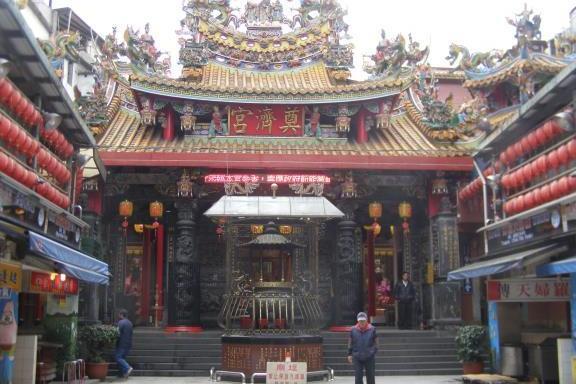
The "temple" in Keelung Miaokou Night Market refers to Dianji Temple, hidden within the market. Built in 1873 (the twelfth year of the Tongzhi reign of the Qing Dynasty), it has a history of over 130 years and is the largest temple in Keelung City. The temple enshrines Kai Zhang Sheng Wang, also known as General Chen Yuanguang of the Tang Dynasty, whose birth date is over 1300 years ago. Kai Zhang Sheng Wang was from Henan. In 686 (the second year of the Chuigong reign of the Tang Dynasty), he was ordered to pacify Fujian and Guangdong. Due to his expansion of the frontier and pacification of the local people, his benevolence extended to Fujian and Taiwan. After his death, he was posthumously honored as Kai Zhang Sheng Wang.
Most of the early inhabitants of Keelung came from southern Fujian, and thus greatly admired the virtue and prestige of General Chen Yuanguang, the Sage King of Zhangzhou; hence, they built a temple in Keelung to worship him. At that time, local gentry and others purchased more than ten hectares of land on Waimu Mountain as temple property, and built the temple on it with timber. However, later, the prominent Lin Benyuan family of Banqiao donated the site at its current location in Wangtian Village, Ren'ai District, and received enthusiastic support from the local community. It was completed in the first year of the Guangxu reign of the Qing Dynasty (1875 AD). At that time, Dianji Palace was exquisitely crafted and very magnificent. Dianji Palace was also destroyed by bombing during World War II, and after years of wind and rain erosion, the temple was in a state of disrepair. In 1964, local people donated funds to rebuild it and added the front hall and the bell and drum towers in the two corridors, giving Dianji Palace in Keelung its present scale.
The size of a temple and the status of the deity worshipped are generally distinguished by the number of steps leading into the temple. The main deity worshipped at Dianji Palace is General Chen Yuanguang, the Holy King of Zhangzhou, and other deities are also worshipped. Although the Holy King of Zhangzhou is not ranked very high among Taoist deities in general folk beliefs, he holds a supreme position in the hearts of Zhangzhou immigrants. The legendary Holy King was a military scholar in the Tang Dynasty. He not only quelled the rebellion on the border between Fujian and Guangdong, but also petitioned to establish Zhangzhou. After his death, the local people built temples in various places to commemorate his merits and virtues. Therefore, Keelung uses a "seven-step" temple to worship the Holy King, so Dianji Palace is also called "Holy King Temple".
Stepping into the temple, one is immediately struck by the carved beams and painted rafters, the antique charm of the interior. Incredibly, amidst such a bustling street, there exists such an ancient and thriving temple, attracting waves of worshippers year after year. Every year on the 15th day of the second lunar month, Dianji Palace and its co-organizer, Deyitang Group 10, hold a ceremony early in the morning, followed by a procession and temple visit in the afternoon. On the same day, the Dianji Palace Management Committee also hires Taiwanese opera performers for two days to pray for favorable weather. If additional performances are arranged, the festivities can last for three or four days.