
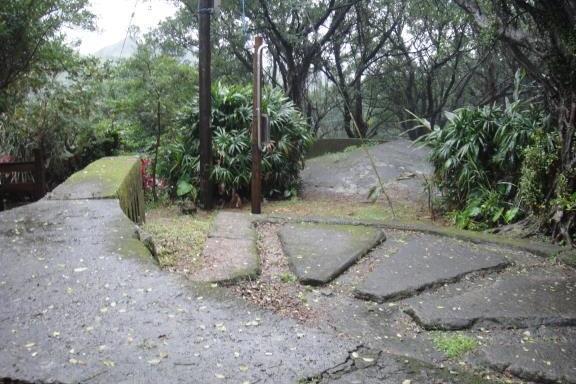
Lion Ridge Fort is a municipal historical site, built in the tenth year of the Guangxu reign of the Qing Dynasty. It is located south of Keelung Harbor. At that time, due to the Annam issue, the French army invaded Taiwan. In order to strengthen the coastal defense, several forts were set up in the Keelung area. Lion Ridge, located south of Keelung Harbor, was the highest of the Keelung forts and had a good view, so it could effectively control the entire harbor.
Lion Ridge Fort is said to have been built by British engineers hired by Liu Mingchuan, the governor of Taiwan, to strengthen coastal defenses and resist French invasion. The main structural material is mountain rock, and despite being over a century old, its structure remains exceptionally sturdy. It is one of the few remaining small forts from the late Qing Dynasty, possessing extraordinary historical value. Furthermore, its commanding position offers panoramic views of the entire Keelung Harbor area from its summit.
Lion Ridge Fort is the most inland and highest fort in Keelung Harbor. Due to its advantageous location, it was able to effectively control Keelung Harbor and played a defensive role in both the Sino-French War and the Sino-Japanese War. During the Japanese occupation of Taiwan, Lion Ridge Fort was abandoned and gradually lost its military function. Currently, only a stone command post, gun emplacements, and ammunition depot remain.
The walls of the fort's command post were constructed of mountain rock and rammed earth, while the roof was made of incredibly hard iron and cement. The interior featured a corridor with rooms, and the walls were a meter thick, making it a veritable "impregnable fortress." On the west side of the command post was a gun emplacement and sub-wall, extremely thick enough to withstand damage from near-explosive enemy shells. At the base of the wall were pointed arched ammunition storage holes for emergencies. The remains of the fort's gun emplacements presented a fan-shaped plan, with the lower section containing the cannons, and a slightly higher section originally containing curved tracks. The radial trenches were drainage ditches, demonstrating a remarkably sophisticated design.