
Xiandong Rock is located in Xiandong Village, Zhongshan District, Keelung City. Legend has it that immortals once cultivated their Taoism here and ascended to heaven, hence the name "Xiandong" (Immortal Cave). It is a natural sea cave, formed by the impact and erosion of seawater over tens of thousands of years, resulting in the unique cave landscape we see today. In earlier times, the cave faced the sea, and those inside could hear the sound of the waves crashing on the shore, hence the saying "Listening to the Tide in Xiandong," which was one of the eight scenic spots of Keelung in the past. Unfortunately, this scene no longer exists after the construction of the port.
"Xiandong Rock" is about 80 meters deep and is the largest sea cave in Keelung. Its shape is like a bell and the walkways inside are arranged in an inverted "claw" shape. It is mainly divided into the main cave, the left cave and the right cave. The temple in the cave is very popular. The main cave is the "Yuantong Hall" which is dedicated to Guanyin Bodhisattva and attracts many pilgrims to come and worship and pray for blessings.
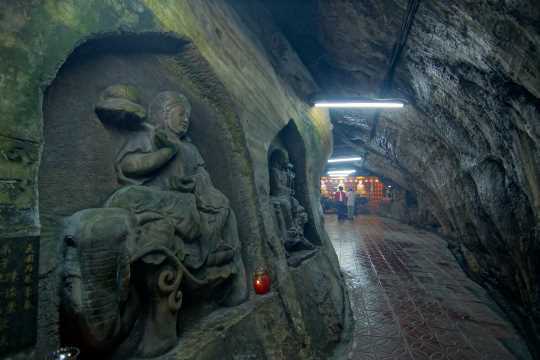
The right cave is spacious, and in addition to the Three Jewels Buddha enshrined there, the rock walls on both sides are carved with images of Guanyin Bodhisattva, Manjushri Bodhisattva riding a lion, Samantabhadra Bodhisattva riding an elephant, Ksitigarbha Bodhisattva, Mahasthamaprapta Bodhisattva, and others, creating a majestic and solemn atmosphere. Furthermore, the cave contains a stone Guanyin Buddha remnant from the Japanese occupation era, and the rock walls are inscribed with numerous calligraphic works left by literati and scholars during the Qing Dynasty.
As for the left cave, stretching over eighty meters, it is the most mysterious and thrilling place, a favorite among those seeking adventure. The path inside is so narrow that only one person can pass sideways, earning it the famous "One Line Sky." The winding paths within the cave vary in width and undulation, becoming increasingly narrow as one goes deeper, requiring one to crouch or bend over to enter. After passing through a section where one must crouch and walk sideways, the view suddenly opens up, revealing a hidden paradise – a sight that always amazes visitors and is a unique experience. Most intriguing is a large, square rock at the bottom of the cave, called the "Fairy Table." On either side of it, directly in front, are two recessed platforms, one large and one small, called the "Fairy Beds," adding to the fascinating history and legend of Fairy Cave Rock.